Tuesday, October 14, 2008

EP Oct1: The living fossils - crionoids!


(photo courtesy of Ze Eduardo, from Flickr)

I was having a hair cut in Makati, browsing this Nat Geo magazine, and got mesmerized by fabulous pictures of Feather Star Crionoids.

This is one of the many see-but-ignore species in the coral reef, and up until our dive-shoot, I didn't really give it much attention.

And so inspired by the NatGeo magazine - I pitched the story for Born (to be Wild), not just the feather star (that will not suffice for 1 Episode), so we'll tackle its clan instead - ECHINODERMS.

Echinoderm family includes:
-sea cucumber (a big fat 'worm' looking thing, growing several inches to several feet long, favorite chinese ingredient for pancit/ etc. Some areas experience over-harvesting.

-sea urchin. Everybody seems to know this one :) for who wants to be pricked by its toxic needles? I was demonstrating how it is properly handled (underwater), but after several demo, i got careless and got stinged by one, arggh! Well, i'm used to marine toxins - i'll live! Its role is to eat algae (too much algae destroys corals, and promotes bacterial growth w/c consumes dissolved O2 - w/c kills fish hehe haba!). Some areas also experience over-harvesting - favorite japanese sashimi called 'Uni'. YUCK!! even w/ 2-3 gulps of beer, i still don't find the taste agreeable.

-sea star. (normally called 'starfish', hey it's not a fish). I was amazed that super-tiny crustaceans actually live somewhere on the sea star's skin. We got one on video :) Since they don't move as fast, they're easy targets for deco collectors. Pricks! Leave the animal where they belong, and let them clean our sea floor ;)

-brittle star. We normally see this at night, it's weird to feel its thorny 'tentacles'. They crawl like little octopus, probably the fastest-moving echinoderm? if you call 1-2in/sec as fast hehe.

FEATHER STAR
I was like a junior scientists (a.k.a. 'Uzi'), examining different types of this unique creature - and WOHAA! to my expectation (based on the nat geo info), Feather Stars do host a number of small creatures living 'inside' it. Little crustaceans (crab-shrimp looking guys) rely on crionoids for home and food. Star's thorny/bushy 'tentacles' protect the homebuddies from predators (more like a moving 'coral').

F.Star survives by making 'abang', it will spread its galamays, catching small planktonic / organic debris from the natural agos / current, and slides down these particles onto its 'mouth'. It has very few predators (ex. triggerfish) - but then, who would want a tasteless, thorny food for meal? Stars are also not taken out of the water like sea stars, coz they're useless as decorations.

Maybe that's its formula on why it thrives and survives. It will definitely continue to survive and will definitely outlast humans. Imagine, 300Million years and counting, preceding and outlasting the dinosaurs.

A truly magnificent creation, a true-blue survivalist, a living fossil - that's our - Feather Star.

Sunday, September 21, 2008

WILD NEWS - Slaughtering of our Sharks!


Depressing and disturbing photos recently taken (wk of Sept15.08) in Donsol Sorsogon area.
Sharks - mostly dogsharks (their livers, one picture here showing that, used for Squalene products according to our source), and tresher sharks, and even threatened species like Manta Rays.
Contrary to myths:
- Sharks are generally not a threat to humans - it's the other way around. In fact, they protect our fish supply from mid-level predators, "clean up" our oceans of dead animals, among other things.
- Shark fin soup consumption is not a status symbol of any kind (mayaman? susyal?), nor it gives you healthful benefits. It could, however be a 'status symbol' for IGNORANCE and stupidity.
Threat to sharks, and other marine life, is a long-term threat to human survival. Without a complete, functional, working eco-system, the entire biosphere could collapse. We're talking about an unsustainable harvesting of sharks here - by the hundreds and thousands!!
Is this a case of 'fishermen in need'? We all know that this is not the case. They just want extra, quick buck.
Is this a case of LGU neglect? We don't know - but Donsol area is known for 'protection and conservation of whalesharks' - so why the irony?
Is this case of general lack of awareness? For sure, let's all fight to conserve what's not ours to abuse.
What can we do? Boycott any shark products. Educate people. Tell your friends about this. Volunteer in NGO ex. WWF work in Donsol, or as Ocean Defender for Greenpeace (google the sites).
Start writing emails about this.... now!

Wednesday, September 17, 2008

EP Sep3 - The Cleanest River!


I'm glad that we still have a few spectacular spots in the Philippines that are not yet destroyed by commercialization or simple abuse. BUGANG river in Panay island is REALLY super clean. I've seen several aquatic plants growing abundantly in the river, serving as its natural filtering (purifying) system, some fish, and even (accidentally) drank water from it.


I guess the better part of it is that, the water source is an underground river - safe and away from the polluting activities common to any human community. The only visible, open stretch is 6 kilometers of clean water flowing downstream to the open sea.

Let's see:

> Potable water above normal drinking standard. CHECK!

> Nipa and mangroves growing in the banks and brackish water section of the river - serving as 2-way protection of the sea (from human trash and corrosion) and the inland (from sea tides). CHECK!

> Healthy system with fish and aquatic plants. CHECK!

> Controlled commercialization (they only opened 1 portion for public use, but very small and manageable). CHECK!

> Pollutants and garbage under control by local management (local volunteers even have regular clean-ups). CHECK!


Well, no wonder - it is the cleanest river in the Philippines!

Monday, September 1, 2008

Aug27 Ep - Apo Island


Note: Apo Island is in Visayas, south of Dumaguete, not to be confused with 'Apo Reef' w/c is in the west of Mindoro mainland, Luzon. Mt. Apo is a mountain hehe, not an island, and is in Mindanao. Apo Reef is known for sea turtles and small reef sharks (as in ang dami ko nakita dati, every dive).


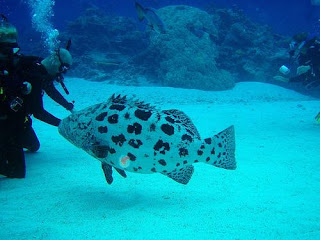
I've been diving for quite a considerable time, but this was the first time that I got a chance to visit the dive sites around Apo Island. And as a pleasant surprise, I had a few 'firsts' on this trip. Unang-una: i've never (ever) seen a Potato Cod in the wild. I've seen a few in the Seaworld ocenarium in Indonesia (I think that was Indo) and another oceanarium in Osaka Japan. But seeing them in the wild, diving in a reef - that was a first. Malaki siya, probably 3ft in length, and 1ft thick at least. See sample photo borrowed from flickr.com/photos/claudioangelini.


Of course sea turtles are also common in the area. I had a few minutes of 'bonding moment' with a hawksbill sea turtle, swimming with this elegant creature just 1-2 feet away. Amazing!

Another first for me was to see a monstrous lone Jackfish (talakitok), it is at least 3/4 of my total body size, maybe even more. I momentarily froze by the glimpse of it, unfortunately - it swam behind me, just a mere 2 meter away, so I only saw it briefly. But the size is really something for the books!

Corals abound in different shapes, sizes and colors - a truly awesome underwater paradise. Mabini/ Anilao is already spectacular - and Apo Island is probably an equal rival.

One message from this trip; the local community worked hard (and still working hard) to preserved their marine treasures. They've worked together to stop unsustainable fishing methods (ex. dynamite w/c destroys the coral reef), educated their community on conservation work - and after years of patience, they are finally earning their pay. A healthier reef gave them more bountiful fish catch. On top, eco-tourism (divers) frequent the place and hence, provide more profits for the community.

"Save the reef and save our future."

Wednesday, August 27, 2008

EP Aug13 - Soaring in the Sky


After a long wait, I finally got a chance to observe our very own Philippine Eagle in the wild. Grabe ang gara at ang laki talaga niya!

The first time I saw this kind was after my Mt. Apo climb way back 1995 (?), in Davao Phil Eagle Center. But this time, we were able to join a team of observers from the Phil Eagle Foundation who were tasked to track, monitor and record relevant data of how this magnificent bird live in the wild.

It's sad that this apex predator is losing its habitat, which is probably the main cause of its 'critically endangered' status. Now if we can only plant more trees, or conserve our forest - w/c means - less wood furniture demand from us, then baka sakaling we can help a bit in preserving our national bird from extinction.

Some new bits that I've recently learned: This eagle learns to hunt and kill on its own, without getting lessons from its parents. Unlike lions or other mammal predators, Phil Eagle seems to 'know' the how-to's thru genetic programming. Also interesting, is the fact that they 'know' that they're not suppose to eat mammal's hair (hence, their pluck-before-eating routine), nor eat their kill's intestine. Aba, may arte rin pala siya :)

You want to actively help? You can volunteer as field observer (and get a chance to see this bird in the wild) or participate in educational campaigns - visit http://www.philippineeagle.org/

(Photo courtesy of Neil Mallari)

Thursday, August 7, 2008

EP July23/30 - Palawan Chronicles


Finally, I was able to have a close (really close) encounter with our very own Tandikan - a.k.a. Palawan Peacock Pheasant. Obviously (from the name), it's endemic to Palawan, and it's a ground dwelling bird like our Labuyo (wild manok), or Pugo (Quail).
The male has a metalic blue plumage, but smaller than a labuyo. I was expecting it to be as big as the Danfe (Nepali Peacok pheasant), but I just realized then that Philippine islands are home to small creatures - mammals, birds and reptiles. I shouldn't expected it to be bigger that its counterpart abroad.
As usual, the enemy of this rare bird is human. We cause deforestation and habitat destruction. We also buy wildlife! The wildlife trade in the Philippines never stops.
Sino namimili sa Cartimar ng ibon? If we don't buy, the trading stops. Simple!

EP July9- Alaskan Adventure


I was hoping to spend several days chasing Grizzly Bears & Moose, or spend time fishing Salmon (as if I eat salmon!), or cruise the bay to watch for big Whales, but the Denali climb was long, and my body - weary, from the tough climb.

Well, I may have climbed the summit, but the memory of that close-to-hell encounter, of a falling team member, of winds reaching 30mph, of an iced face and mitten-less left hand, in temp of -15 to -20C w/ windchill - on a freakin' summit knife ridge above 20,000ft - made me like my zoo visit more than my trip to the peak. :)

I have no more time to spare, so I literally run around the Alaska zoo to take a good glimpse of Polar bears, black and brown (grizzly) bears, moose, caribou (you say 'reindeer' if it's farmed and not wild), wolves (that just look like big dogs), dahl sheep, lynx (pusang malaki, pusang wild, na hindi pusa hehe), and a lot more.

Alaska is the biggest state of USA, but the population is just around 800,000 people. So don't be suprised if nature is teeming with wildlife. The biggest salmon, the biggest whales, the biggest bear! You name it! This is a very good example of how nature is preserved, when humans are outnumbered by wildlife (sort of). Less people in the area = more preserved habitat = more wildlife. (So let's push for the Reproductive Health Bill (-Family Planning?) if we want to save our few-remaining treasures in the Philippines - HAHAHA!)